

Preventive Interventions
DOVE has conducted three evaluation studies of preventive interventions aiming to support positive child development, reduce violence against children, and reduce overall violence in the city of Pelotas.
Pelotas Parenting Intervention for Aggression (PIÁ) Trial
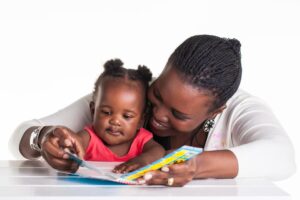
The PIÁ Trial is a randomized controlled trial that evaluated the impact of two early parenting programmes on child behaviour, cognition, socio-emotional functioning, and parenting practices. The first programme was a dialogic book-sharing parent-training programme (DBS), developed by the Mikhulu Trust and promoted by the WHO Parenting for Lifelong Health Initiative. It aims to promote sensitive parenting and child cognitive and socio-emotional development. The second programme is the ACT Raising Safe Kids Program (ACT), developed by the American Psychological Association, and designed to reduce harsh parenting and violence. They were selected for implementation by the Pelotas municipal government as free and short, group-based interventions that can be implemented by community workers in lower resource settings.
The effects of ACT and DBS were estimated among poor families in the 2015 Pelotas Birth Cohort Study, by randomly allocating 369 participating families to one of the three groups (DBS, ACT, Control – services as usual) when children were aged 3 years. Detailed assessments of parenting and child development were made before the programmes, shortly afterwards, and at follow-up eight months post-intervention, when 368 (99.7%) of the original trial sample was reassessed. There was quite good adherence to both programmes and participants reported good experiences in each. ACT reduced harsh parenting behaviours immediately after the intervention, although this effect was not maintained at the 8-month follow-up. DBS was found to improved positive parenting at both time points. However, neither ACT or DBS had benefits on the primary outcome of child aggression 8-months post-intervention. New analyses are underway examining possible medium-term effects, 2 years post-intervention (during the critical period of the COVID-19), and 3–4 years post-intervention (when children were 6–7 years old, at school entry age). The preregistered statistical analysis plan for Phase 2 can be found here: https://osf.io/jaquk.
Publications
Murray J, Santos I, S Bertoldi A D, Murray L, Arteche A, Tovo Rodrigues L, Cooper P. The effects of two early parenting interventions on child aggression and risk for violence in Brazil (The PIÁ Trial): protocol for a randomised controlled trial. BMC Trials 2019; 20(1): 253. PDF
Martins RC, Machado AKF, Shenderovich Y, et al. Parental attendance in two early-childhood training programmes to improve nurturing care: A randomized controlled trial. Children and Youth Services Review. 2020;118:105418. doi:10.1016/j.childyouth.2020.105418.PDF
Murray J, Martins RC, Greenland M, Cruz S, Altafim E, Arteche AX, Cooper PJ, Domingues MR, Gonzalez A, Machado AKF, Murray L, Oliveira I, Santos I, Soares TB, Tovo‑Rodrigues L, Voysey M. Effects of Two Early Parenting Programmes on Child Aggression and Risk for Violence in Brazil: a Randomised Controlled Trial. Prevention Science. 2024; 25:834-848. PDF
Impacts of the PIM Home-Visiting Programme
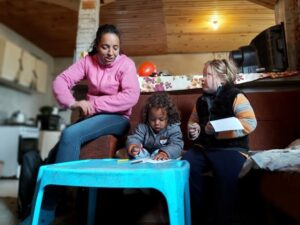
Primeira Infância Melhor (PIM) is a large-scale home-visiting programme implemented across the state of Rio Grande do Sul, in southern Brazil. PIM focuses on families with greater social vulnerability and has served more than 300,000 children and 75,000 pregnant women since 2003. It aims to enhance sensitive and responsive caregiver-child interactions through engagement in age-appropriate play activities, along with provision of information for nurturing care and facilitating access to health and social services. Nested within the 2015 Pelotas Birth Cohort Study, a series of quasi-experimental evaluations (using propensity scores and other methods) have assessed the impacts for over 600 cohort families who received PIM up to age 4 years. The quasi-experimental nature of the studies enabled the investigation of PIM’s impact under routine implementation conditions.
The most relevant results indicated that: participation in PIM from pregnancy improved children’s socio-cognitive development at age 4 years. However, considering enrolment in PIM at any time (including after birth), there was not evidence of a benefit of PIM on child development. PIM increased the likelihood of having an adequate number of prenatal care visits, among those who started the intervention during pregnancy. Participating in PIM produced positive effects on parenting, in terms of parental responsiveness and sensitivity when children were aged 4 years, with stronger effects on sensitivity for low-income parents.
A further study considered the best pregnancy variables that might be used as an initial screen to consider families for inclusion to PIM. Maternal and paternal education levels were the strongest predictors of child development and deemed most appropriate for this purpose, and an online tool was created for initial population-level screening of pregnant women for PIM and similar programmes (https://ecdprograms.shinyapps.io/ECDPrograms/).
Publications
Viegas da Silva E, Hartwig FP, Barros F, et al. Effectiveness of a large-scale home visiting programme (PIM) on early child development in Brazil: quasi-experimental study nested in a birth cohort. BMJ Global Health 2022;7:e007116. doi:10.1136/ bmjgh-2021-007116. PDF
Healy MR, Viegas da Silva E, Lundborg AR, et al. Towards a better understanding of real-world home-visiting programs: a large-scale effectiveness study of parenting mechanisms in Brazil. BMJ Glob Health 024;9:e013787. doi:10.1136/ bmjgh-2023-013787. PDF
Viegas da Silva E, Hartwig FP, Yousafzai A, et al. The effects of a large-scale home visiting programme for child development on use of health services in Brazil. Health Policy and Planning, 39, 2024, 344–354. PDF
Viegas da Silva E, Hartwig FP, Santos TM, et al. Predictors of early child development for screening pregnant women most in need of support in Brazil. J Glob Health 2024;14:04143. PDF
Effects of the Pelotas Peace Pact on Violence and Crime
The Pelotas Peace Pact (the “Pacto”) is a public policy initiative launched by the Pelotas municipal government in 2017 to tackle the city’s growing problem of violence and crime. The initiative used an integrated approach to combat root causes of violence, such as limited access to basic services and economic opportunities, alongside more traditional criminal justice approaches, such as hotspot policing and deterrence. The Pacto has become internationally recognised as a flagship city-led violence prevention programme, and resulted in Pelotas being named as the world’s third “Pathfinder city” in the United Nations initiative to “End Violence Against Children”.
In a study published in The Lancet Regional Health – Americas, the DOVE team evaluated the effects of the Pacto on city-wide crime and violence. By using novel quasi-experimental methods, it was estimated that the Pacto resulted in a 9% reduction in homicide and 7% reduction in robberies – that is 23 fewer homicides and 704 fewer robberies between August 2017 to December 2021. These reductions intensified during the COVID-19 pandemic, which stakeholder interviews attributed to the cross-sector strategy fostered by the Pacto. While the short-term effects of the Pacto are promising, continuous monitoring and evaluation is needed to understand its long-term impact on the city.
Publications
Degli Esposti M, Coll CVN, Viegas da Silva E, et al. Effects of the Pelotas (Brazil) Peace Pact on violence and crime: a synthetic control analysis. The Lancet Regional Health – Americas 2023;19: 100447. PDF

